

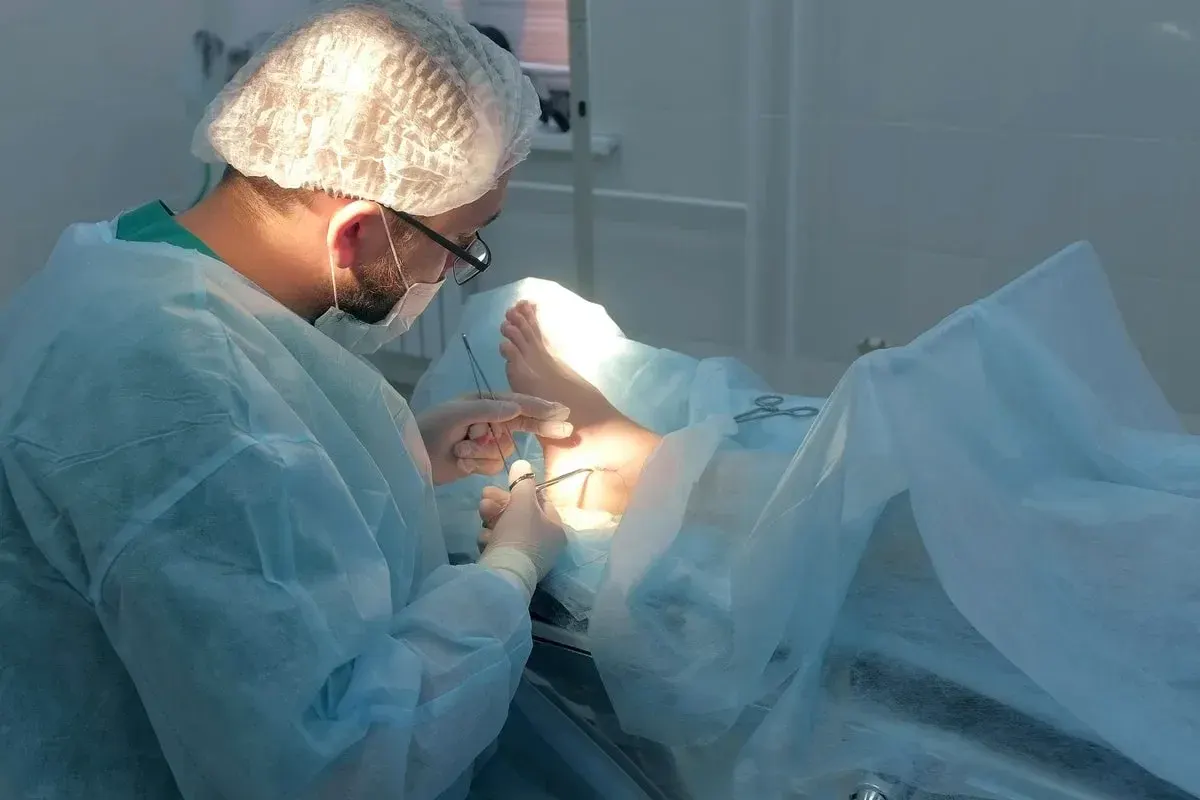
Hearing that you might need foot surgery can feel overwhelming. The good news is that most foot and ankle problems are treated without an operation, and when surgery is recommended, it is usually a planned procedure with a clear goal: relieving pain, correcting a deformity or repairing an injury so you can walk comfortably again.
This guide walks through the most common types of foot surgery in plain language, when each one is considered, and what to expect before and after. It is general information to help you prepare for a conversation with your podiatrist, not a substitute for a personal evaluation. To learn how our team approaches operations, visit our surgical care page.
For most conditions, podiatrists start with conservative care such as supportive shoes, custom orthotics, padding, physical therapy, medication or bracing. Surgery becomes one of your foot surgery options when:
Your overall health, activity level, circulation and personal goals all factor into the decision.
Below are the common foot surgeries podiatric surgeons perform. The exact technique varies from patient to patient.
A bunion is a bony bump at the base of the big toe that forms as the toe drifts toward the others. A bunionectomy removes the bump, and an osteotomy carefully cuts and repositions the bone to straighten the joint. The bone is often held with small screws or pins while it heals. Several techniques exist, and the choice depends on the size of the bunion and the health of the joint.
A hammertoe is a toe that bends at the middle joint. When the toe is still flexible, releasing or transferring a tendon may be enough. When it is rigid, a small section of bone at the joint may be removed or the joint straightened and held with a pin or implant while it heals.
A Morton's neuroma is a thickened, irritated nerve, usually between the third and fourth toes, that causes burning or a pebble-in-the-shoe feeling. If padding, shoe changes and other conservative care do not help, the surgeon may remove the affected section of nerve or release the ligament pressing on it. Some lasting numbness between the toes is common afterward.
For long-lasting plantar fasciitis that has not improved with months of conservative care, a partial release of the plantar fascia may be considered. The surgeon cuts part of the tight band to reduce tension on the heel and arch. Most people with plantar fasciitis never need this step.
A heel spur is a bony growth on the heel bone. The spur itself is often not the source of pain, so removal is usually considered only in specific cases and is sometimes combined with a plantar fascia release or Achilles procedure.
When the Achilles tendon ruptures or is badly damaged by long-standing Achilles tendonitis, surgery may reconnect the torn ends, remove damaged tissue or reinforce the tendon. Other tendons in the foot and ankle, such as the posterior tibial tendon that supports the arch, can also be repaired or rebuilt.
Open reduction and internal fixation, or ORIF, is used for fractures that are displaced or unstable. "Open reduction" means the surgeon lines the broken pieces back up, and "internal fixation" means holding them with plates, screws or wires while the bone heals. Our fracture care page explains how non-surgical and surgical options compare.
Ankle arthroscopy is a minimally invasive procedure in which the surgeon uses a small camera and instruments through tiny incisions to look inside the joint. It can be used to remove loose fragments, smooth damaged cartilage or treat scar tissue, often with a smaller incision than open surgery.
A fusion joins two or more bones so the joint no longer moves. It is used for severe arthritis, significant deformity or joint instability. Removing the painful motion can relieve pain, but that joint will be stiffer afterward, which your surgeon will discuss with you.
For a painful or infected ingrown toenail, a podiatrist can remove the ingrown edge of the nail. If the problem keeps coming back, the nail root at that edge may be treated so it does not regrow. This is typically a quick in-office procedure with local anesthesia.
Minor procedures, such as ingrown toenail removal and some small soft-tissue procedures, can often be done in the office with local anesthesia, and you walk out the same day.
Larger surgeries, such as bunion correction, tendon repair, fracture fixation, arthroscopy and fusion, are usually performed in a hospital or outpatient surgery center. You may receive local anesthesia with sedation, a nerve block or general anesthesia. Many of these procedures are still same-day surgeries, while some patients stay longer depending on the operation and their health.
Recovery time depends on the procedure. An ingrown toenail procedure may require only a short break from normal activity, while bunion correction, tendon repair, fracture fixation and fusion typically require weeks of protected walking and a longer period before returning to sports. Swelling can last for months, even when healing is going well.
For practical aftercare tips, read how to care for your feet after foot and ankle surgery and habits to avoid during foot surgery recovery. Many patients also benefit from in-office physical therapy to rebuild strength, balance and range of motion.
See a podiatrist if foot or ankle pain keeps you from walking comfortably, if a bunion or hammertoe is getting worse, if you have a painful bump or numbness that does not go away, or if you injure your foot and cannot bear weight. Seek care promptly for a foot that looks deformed after an injury or for signs of infection such as redness, warmth and drainage.
At Southernmost Foot & Ankle Specialists, we start by finding the cause of your pain and exploring conservative care whenever it is appropriate. When surgery is the right next step, we explain your options clearly so you can make an informed decision. We see patients in Key West, Homestead and Coral Gables, and walk-ins are welcome. Call us toll-free at 855-300-6685 or schedule an appointment.
Bunion surgery, hammertoe correction and ingrown toenail procedures are among the most common foot surgeries. Which procedure is right for you depends on your diagnosis.
You will be numb or asleep during the procedure. Some pain and swelling afterward is normal and is managed with elevation, ice, rest and the medication your surgeon recommends.
It depends on the procedure. Some patients can walk in a surgical shoe or boot soon after surgery, while others need to keep weight off the foot for several weeks. Always follow your surgeon's weight-bearing instructions.
Not always. Many foot fractures heal with a cast, boot and rest. Surgery is usually considered when the bones are out of place or unstable.